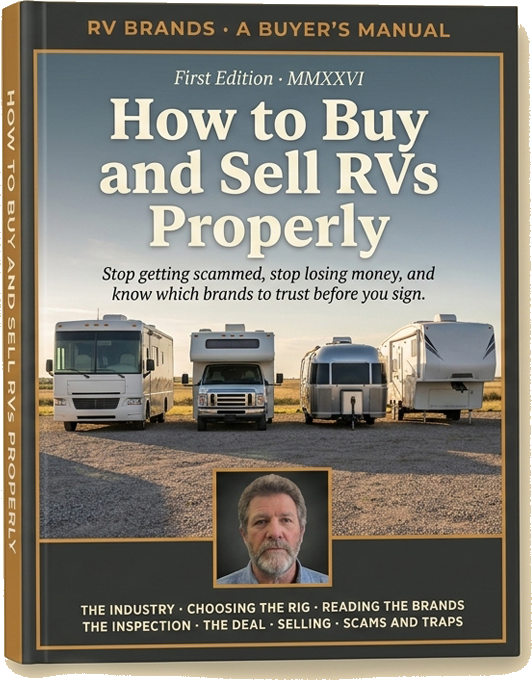
An RV is not a house and it is not a car, and almost every expensive mistake in this hobby comes from treating it as one or the other. So we wrote down the whole thing: how the industry actually works, how to score any brand yourself in forty minutes, what to inspect and in what order, and what the out-the-door number really is before you put a pen anywhere near a contract.
Instant download · Yours forever

You almost certainly arrived here from a video that named brands. Named the ones falling apart, named the ones still worth buying. Those videos are honest work and we stand behind them. But a printed brand ranking has a shelf life of roughly one model year.
Ownership changes. A plant reopens under new management. A supplier contract turns over and a brand that was building junk in the spring is building acceptable rigs by the fall — or the reverse, which happens just as often and hurts far more. So a book that printed a list of good brands and bad brands would be wrong by the time you finished reading it, and you would have paid for the wrongness. Worse, it would teach you nothing. You would know one list, for one year, and be right back where you started the next time you went shopping.
This book does the other thing. It teaches you to score any brand yourself, in about forty minutes, from public records you can pull for free — and to do it again next year, and the year after, on whatever the industry looks like then. The nine-point scorecard in Chapter Fifteen is the centre of the book. Everything before it explains why the scores mean what they mean. Everything after it is how you turn a score into a price, an inspection, and a signature.
Understanding that one fact explains water intrusion, delamination, frame flex, cabinet failure, and a great many of the complaints you will read online. It is also why the same buyer who would never accept a soft floor in a house walks past one on a lot without noticing it.
Every method in here is something you can do yourself, on a lot or in a driveway, with a flashlight and a notepad, before any money changes hands. Where something costs money, we give a figure. Where a method has a limit, we say so. Where you need a licensed technician, a certified inspector, or an attorney, we say that too — in the chapter, before you need it.
We are not here to talk you out of an RV. We own them. They are worth owning. We are here so that the one you buy is the right one at the right price, and so that when the day comes to sell it, you get out with your money instead of discovering what the word depreciation means at the worst possible moment.
Same lot, same rig, same salesman. The only thing that changes is what you know before you walk in — and where in the book it is written down.
Every dollar figure in the book is a scale marker in 2026 United States dollars, drawn from typical retail and typical repair, so you can weigh one choice against another — an inspection against a repair, a fee against a walk-away. They are not quotes and they are not predictions.

It is arranged in the order a real purchase happens: understand the industry, choose the type, judge the brand, inspect the unit, make the deal, take delivery, protect the value, and eventually sell. Every chapter ends with a single line — The Move — the one action to take if you remember nothing else from those pages.
Why the product in front of you is built the way it is, and where the money quietly goes.
Matching the machine to the trips you actually take, and to the truck you actually own.
The centre of the book. The scorecard that replaces every list you have ever read.
A flashlight, a notepad, and a fixed order. The longest part of the book, on purpose.
Turning what you found into a number, and holding that number in the room.
The hours after the signature, and the habits that decide what it is worth in four years.
Getting out with your money — pricing, timing, photographs, screening and handover.
The four categories of trouble that money cannot repair afterwards.
Instant download · Yours forever
"I read the water chapter on a Friday night and found a soft spot in front of the shower on the Saturday. Walked away. Two weeks later I bought a better rig for less money and I have never once wondered what I got away with."
Dale R. · Missouri
"Scored three brands on the sheet before I went anywhere. Took me an hour each. The one I had my heart set on came out lowest, and the reasons were sitting in the recall record the whole time."
Peggy L. · Oregon
"I have been RVing eleven years and I still learned what half those fees on my last contract actually were. Wrote the walk-away number on a card, kept it in my shirt pocket, and used it."
Ron V. · Texas

We are a channel about recreational vehicles and the people who sell them. We are not a dealership, not a manufacturer, and not sponsored by either.
The videos name brands because in a given month that is a useful thing to know, and because somebody should say it out loud. But the questions in the comments are almost never really about brands. They are about a soft spot near the shower. A quote with four fees on it that nobody would explain. A title in someone else's name. A tow rating that turned out to mean something different from what the salesman said it meant.
Those questions do not fit in a video. A video has to end, and it ends before the part where you actually need to know what to do on the lot on Saturday morning. A page does not end. So we wrote the whole thing down, in the order a real purchase happens, and put the worksheets at the back so you can carry them with you.
You will not find a list of manufacturers named as good or bad in these pages. That is deliberate, and Chapter Fourteen explains it in full. What you will find is the framework that produces such a list — yours, current, and specific to the rig standing in front of you.
We would rather you walk away from four rigs and buy the fifth one properly than get talked into the first one on a Saturday afternoon.

Instant download · Yours forever
No, and Chapter Fourteen is the honest explanation of why. A printed ranking has a shelf life of about one model year — ownership changes, plants change management, supplier contracts turn over. You would have paid for a list that was already wrong, and you would have learned nothing you could use the next time. What the book gives you instead is the nine-point scorecard that produces such a list: yours, current, and specific to the rig in front of you. It does not rank, endorse or disparage any manufacturer.
A video ends. It usually ends right before the part you actually need — the order to inspect in, the fee you are looking at on the contract, the four checks on the title. This is all of it in one place, in the order a real purchase happens, with the worksheets you can print and carry. Most of what is in here has never been in a video, because it does not fit in one.
No, and we say so on page five. It will make you competent enough to know when you need one, confident enough to insist on it, and far better able to use the report when it arrives. Chapter Thirty-One is entirely about when to hire a certified inspector and what to ask them for. Propane, electrical, chassis, brake and structural work belong to qualified technicians.
Because it is a PDF and it costs us nothing to hand you one more copy — and because one avoided deposit, one caught soft floor, or one invented fee taken off a contract is worth many times the price. $47 is what it goes to when the launch promo ends.
They are scale markers in 2026 United States dollars, drawn from typical retail and typical repair. They are there so you can weigh one choice against another — an inspection against a repair, a fee against a walk-away. They are not quotes, not valuations and not predictions. Your region, your season and your negotiating will move all of them.
It covers the checks and the order to do them in: the VIN read off the plate and matched character by character against the title, the name on the title against the seller's identification, and the lien section released in writing. What it will not do is tell you what your state requires, because titling, tax, lien, registration and disclosure rules differ everywhere and change regularly. Where those matter the book tells you which question to ask and who to ask it of, and then it stops.
Part Four, tonight. Chapters Twenty through Thirty-One are the inspection, and Chapter Twenty-Three — water intrusion — is the one to read first if you only read one. Then Part Five before you sit down at the desk. The rest can wait until after.
A single illustrated PDF, 144 pages, delivered the moment you order. Read it on a phone, tablet or laptop. The four worksheets at the back are meant to be printed — one inspection sheet per rig you view, and a blank scorecard for each brand you grade.
Parts Six and Seven are written for you. What the maintenance actually protects, where the rig should sit between trips, the folder that adds money at sale, what your RV is genuinely worth, when to list it, and the weekend of preparation that pays the most. Most owners lose more at the sale than they ever lost at the purchase.
That is what fifty-three chapters cost you today. One caught soft floor, one invented fee taken off a contract, or one deposit not sent is worth many times it — and the inspection sheet at the back is printable before your next Saturday.
Get the Manual — $47 $27 or see what's inside →